Palermo Hollywood takes its name from its economic DNA: this is where Buenos Aires’ audiovisual industry clustered — TV channels, film production companies, post-production houses, advertising agencies. In recent years, the creative economy has shifted a little, with tech startups and IT companies moving in alongside the studios. The neighbourhood’s character, though, has held: energetic, creative, and more local than touristic. Commuting by bike or e-scooter is more common here than almost anywhere else in the city. Over the years, the neighbourhood’s restaurants and bars developed their own aesthetic vocabulary: a distinctly Argentine reinterpretation of the New York loft-and-brick look — exposed concrete, warm lighting, open kitchens.
Palermo Hollywood is only one part of a much larger neighbourhood: for the full picture — Soho, Chico, the parks — see our complete guide to Palermo.
A neighbourhood for families
The proximity to Bosques de Palermo and the density of public transport make this one of the city’s most practical neighbourhoods for young families. Parents can commute easily and still find a quiet café table on a weekday afternoon. Kids ride scooters on the shaded pavements, and the parks are a short walk away — ducks, rowboats, wide lawns.
Restaurants in Palermo Hollywood


In the early 2000s, Palermo Hollywood became the laboratory of Buenos Aires’ dining scene. In a city where most restaurants served traditional food and grilled meat done impeccably but predictably, this neighbourhood was where experiments happened: Asian bistros, genuine French pastry, Indian dining, true Neapolitan pizza. The city’s food scene is now far more diverse across the board, but the concentration of good tables here remains unusually high. A few we’d point you to:
- Crizia: Gabriel Oggero’s seafood restaurant holds a Michelin star and a Michelin Green Star for sustainability — a rare double. The focus is Patagonian oysters and seasonal products sourced from artisan fishers and small producers across Argentina. The four-storey wine cellar and rooftop kitchen garden are details that reward a second look.
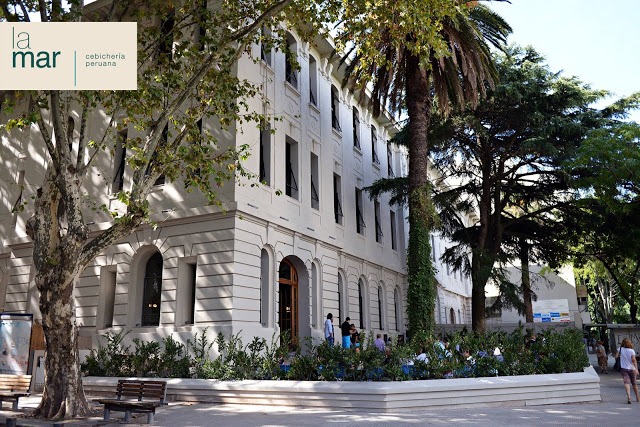
- La Mar: The Buenos Aires outpost of Gastón Acurio’s celebrated Peruvian cebichería. Ceviches, tiraditos, pisco sours and a casona setting that fills up fast — a reservation is not optional on weekends.
- Artemisia: A bright, plant-filled corner spot: salads, falafels, curries, fresh bread, and a few fish dishes — light in every sense.
- Asian Cantina: Christina Sunae — born in the US, raised between Korean and Filipino culinary traditions — began cooking Southeast Asian food for small private dinners in Villa Urquiza before opening this Palermo Hollywood cantina in 2016. The kitchen covers the Philippines, Thailand, Vietnam and beyond; the approach is specific and personal, not generic pan-Asian.
- The Night Market: A Japanese izakaya and sake bar at Gorriti 5612 — ramen, dumplings, and sharing plates in a setting that transports you somewhere firmly east of Palermo. Open evenings only.
- Madrí Bar de Tapas: Spanish tapas served from a magnetic conveyor belt — a kaiten-style bar, borrowed from Japanese sushi culture, adapted here for hot tortillas, chorizo a la sidra, and gambas al ajillo. It works better than it sounds. The beer garden at the back is a good spot on warm evenings.
- Hierro: A modern parrilla with the fire visible from the dining room — the name references the iron itself, the material that conducts the heat in Argentine grill culture. Good meat, modern room — nothing like the traditional parrilla experience.
Bars & nightlife in Palermo Hollywood

Dinner at ten, drinks at midnight, and if things go well, still out at three. Palermo Hollywood runs on Buenos Aires time — which is to say, later than you planned. A few places that cover the full range of the night:
- Uptown & The Bronx: Down a staircase on Arévalo 2030, a replica New York subway station — mosaic tiles, advertising posters, a repurposed metro car — opens into one of the city’s most talked-about cocktail bars. Reservations required; walk-ins are wishful thinking on weekends.
- Niceto Club (Niceto Vega 5510): Open continuously since the late 1990s, Niceto has hosted almost every significant band in Argentine rock as well as major international acts. The formula is simple: live music from 9pm, then a party from midnight. Thursday nights — known as Club 69 — are a Buenos Aires institution in their own right.
- SOFÁ — Un Bar (Av. Dorrego 1301): A neighbourhood bar in the best sense — unhurried, good music on weekends, the kind of place where you can actually hold a conversation before the night accelerates elsewhere.
- PIBÄ House (Costa Rica 5673): Designed by Eme Carranza — the architect behind some of Buenos Aires’ most distinctive dining spaces — PIBÄ House takes the brand’s street gourmet identity and turns it into something closer to a private club. Pinchos, natural wine, and a crowd that arrives late and stays later.
The Flea Market & Arévalo Street


The Mercado de Pulgas on Dorrego Ave is the city’s most atmospheric antiques market. Housed in a vast covered warehouse at the corner of Álvarez Thomas, its 150 stalls span furniture, paintings, sculptures, bronzes, glassware, jewellery, silverware, porcelain, and instruments — a proper cambalache, as the locals say, with enough depth to reward both the dedicated collector and the curious wanderer. It opened in 1988 and was fully renovated and reopened in 2011; open Tuesday to Sunday from 11am.
A short walk up Dorrego, between Conesa and Zapiola, a former grain silo complex has been converted into one of the city’s most unusual residential buildings — the Silos de Dorrego, whose industrial silhouette still marks the skyline.
Running parallel, Arévalo is a quieter counterpoint to Dorrego’s weekend bustle: a tree-lined street of low buildings, small café terraces, and bakery windows. A few places worth knowing:
- Heladería Scannapieco (Álvarez Thomas 10): One of Buenos Aires’ oldest ice cream parlours, steps from the market entrance. The flavour board is vast; the pistachio and dulce de leche are benchmarks.
- Cucina Paradiso Senza Glutine (Arévalo 1538): Chef Donato De Santis converted his original Palermo trattoria into what he describes as the first 100% gluten-free Italian restaurant in Latin America. Order the pasta. Then order the focaccia and try not to think too hard about how it’s possible.
- Atte. Pizzeria Napoletana (El Salvador 6016): Neapolitan pizza from a wood-burning Pavesi oven brought from Italy, fired with quebracho blanco. Thin, blistered, uncompromising. Book ahead.
- Salvaje Bakery (Dorrego 1829): A sourdough bakery using organic flours and long natural fermentation, open from mid-morning. Come for the bread — dense, complex, worth taking a loaf home — and stay for the coffee and brunch before or after the market.
Street art in Palermo Hollywood
Palermo Hollywood is one of Buenos Aires’ most rewarding neighbourhoods for street art — not because it has a designated circuit, but because the work appears where you least expect it: on the corrugated shutters of a bar, the side wall of a car park, the entire façade of a residential building. Artists like Martín Ron — known for hyper-realistic, large-scale human figures — and Cabaio have turned entire buildings into canvases here.


On the border with Colegiales, a two-storey Frida Kahlo at Dorrego 1735 has become one of the neighbourhood’s most photographed corners. Elsewhere, the murals shift and change — a building repainted overnight, a new piece on a shutter you walked past last week. That impermanence is part of it.